Introduction
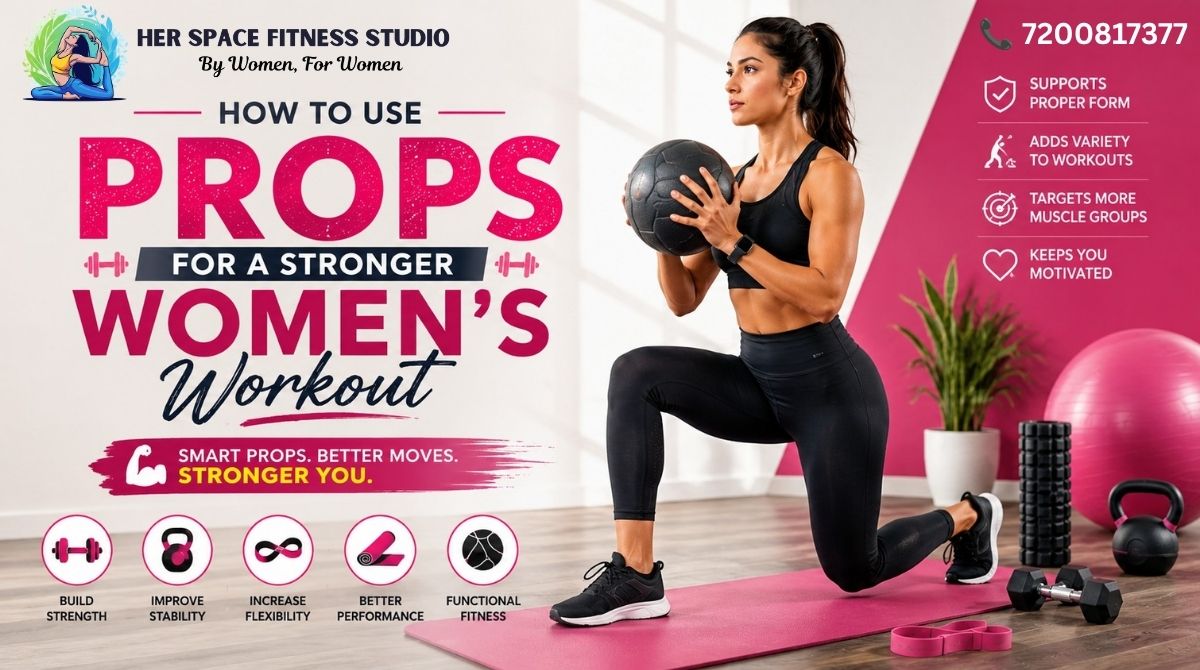
How to Use Props for a Stronger Women’s Workout Strength training is an important part of a balanced fitness routine for women. While bodyweight exercises can provide an excellent foundation, adding simple workout props can make training more challenging, versatile, and engaging.
You don’t need a fully equipped gym to build strength. Resistance bands, dumbbells, ankle weights, Pilates balls, and other simple props can help increase resistance, improve stability, and provide different ways to progress your workouts.
The key is knowing how to use workout props correctly rather than simply adding more equipment.
In this guide, we’ll explore how women can use common workout props to create stronger and more effective workouts at home or in a fitness studio.
Why Use Props During Stronger Women’s Workout?
Workout props can change the difficulty and movement pattern of familiar exercises.
They can help you:
- Increase resistance
- Challenge muscles progressively
- Improve balance and stability
- Add variety to workouts
- Strengthen different muscle groups
- Make bodyweight exercises more challenging
- Create more structured workout routines
However, using a prop doesn’t automatically make an exercise better. The equipment should match your fitness level, exercise technique, and goals.
1. Resistance Bands for Lower-Body Strength
Resistance bands are particularly useful for targeting the hips, glutes, and legs.
A loop band placed around the thighs can add resistance to exercises such as squats and lateral walks.
Try These Exercises
Banded Squats:
Place the band appropriately around your thighs and perform controlled squats while keeping your knees aligned.
Lateral Band Walks:
Take small controlled steps sideways while maintaining tension in the band.
Glute Bridges:
Use a suitable band position and focus on squeezing the glutes as you lift your hips.
Why It Helps
Resistance bands provide continuous tension throughout many movements, making simple exercises more challenging.
2. Dumbbells for Full-Body Strength
Dumbbells are one of the most versatile strength-training props.
Even a pair of light-to-moderate dumbbells can be used for several upper- and lower-body exercises.
Try These Exercises
- Goblet squats
- Dumbbell rows
- Shoulder presses
- Romanian deadlifts
- Biceps curls
- Triceps extensions
- Chest presses
Start with a weight that allows you to maintain proper technique.
Progression Tip
Instead of immediately choosing heavier weights, first improve your movement control and gradually increase repetitions or resistance when appropriate.
3. Ankle Weights for Controlled Leg Exercises
Ankle weights can add resistance to selected lower-body movements.
They can be useful for controlled exercises such as:
- Leg raises
- Glute kickbacks
- Side leg lifts
- Standing leg extensions
Because ankle weights increase resistance at the end of the leg, they should be used carefully.
Important Tip
Avoid swinging your legs or using momentum. Slow, controlled movements are generally more useful than simply adding heavier weights.
4. Pilates Ball for Stability and Core Training
A small Pilates ball can introduce an additional stability challenge.
It can be used during exercises targeting the core, glutes, and inner thighs.
Try These Exercises
- Ball-supported glute bridges
- Inner-thigh squeezes
- Wall squats
- Controlled core exercises
- Stability-focused movements
The unstable element can encourage greater body awareness and control.
Start with simple movements before progressing to more challenging exercises.
5. Yoga Blocks for Support and Alignment
Yoga blocks aren’t only for yoga.
They can also help modify certain strength and mobility exercises by bringing the floor closer to you or providing additional support.
For example, a block can sometimes make a movement more accessible for beginners who don’t yet have the mobility to reach the floor comfortably.
Possible Uses
- Supported squats
- Mobility exercises
- Balance work
- Stretching
- Modified strength movements
Use a stable block and avoid placing it where it could slip during an exercise.
6. Step Platforms for Leg Strength and Cardio
A stable step platform can combine strength and cardio in one workout.
Step-ups work the legs and glutes while also increasing your heart rate.
Try These Exercises
Basic Step-Ups:
Step onto the platform one foot at a time and return to the starting position.
Step-Up With Knee Lift:
Once comfortable, add a controlled knee lift at the top.
Lateral Step-Ups:
Step onto the platform from the side while maintaining control.
Safety First
Make sure the platform is stable and placed on a non-slip surface. Begin with a lower height and progress gradually.
7. How to Combine Props Into a Full-Body Workout
You don’t need to use every prop in one session.
A simple full-body routine could include:
Warm-Up – 5 Minutes
- Marching
- Arm circles
- Side steps
- Bodyweight squats
- Gentle mobility movements
Strength Circuit
Exercise 1: Dumbbell Goblet Squat
10–12 repetitions
Exercise 2: Resistance-Band Row
10–15 repetitions
Exercise 3: Glute Bridge
12–15 repetitions
Exercise 4: Dumbbell Shoulder Press
8–12 repetitions
Exercise 5: Resistance-Band Lateral Walk
10–12 steps per side
Exercise 6: Step-Ups
30–45 seconds
Rest as needed and repeat the circuit according to your fitness level.
Finish with a gentle cool-down.
How to Choose the Right Prop
The best prop depends on what you want to improve.
| Fitness Goal | Useful Props |
|---|---|
| Build lower-body strength | Resistance bands, dumbbells |
| Improve upper-body strength | Dumbbells, resistance bands |
| Strengthen glutes | Bands, dumbbells |
| Improve stability | Pilates ball, yoga blocks |
| Add cardio | Step platform |
| Improve mobility | Yoga blocks |
| Add variety | Combination of props |
You don’t need to purchase everything. Start with one or two versatile options and build from there.
How to Progress Your Workouts
Progressive overload is an important principle of strength training.
As your body adapts, you can gradually increase the challenge by changing one variable at a time.
Increase Resistance
Move from a lighter resistance band to a stronger one or increase dumbbell weight when appropriate.
Increase Repetitions
If you can comfortably perform your target repetitions with good form, you may gradually add a few more repetitions.
Improve Control
Slowing down the movement can make an exercise more challenging without immediately increasing the weight.
Increase Sets
You can add another set when your current workout becomes comfortable.
Change Exercise Variations
Progress from a basic movement to a more challenging variation once you have mastered the fundamentals.
Common Mistakes When Using Workout Props
Choosing Equipment That Is Too Heavy
Heavy equipment isn’t necessary for every exercise. If your form breaks down, reduce the resistance.
Using Momentum
Swinging weights or bands can reduce control and increase the risk of poor technique.
Ignoring Alignment
Pay attention to your posture, knee position, spine, and overall movement pattern.
Progressing Too Quickly
Give your body time to adapt before increasing resistance or workout volume.
Trying Advanced Exercises Too Soon
Master basic movements before adding complex variations.
Using Damaged Equipment
Check resistance bands, steps, mats, and other equipment regularly for signs of wear.
Tips for Women Training at Home
Home workouts can be highly effective when they are structured properly.
Create a small workout area where you have enough room to move safely.
Keep frequently used props somewhere accessible so you’re more likely to use them.
A simple home setup could include:
- A yoga mat
- Resistance bands
- A pair of dumbbells
- A Pilates ball
- Optional step platform
You can create many different workouts with just these few items.
How Often Should Women Do Strength Workouts?
The ideal schedule depends on your fitness level, goals, recovery, and overall activity.
For many women, two to three strength-training sessions per week can be a practical starting point.
You can alternate strength days with walking, cardio, yoga, mobility work, or rest days.
For example:
Monday: Full-body strength
Tuesday: Walking or light cardio
Wednesday: Rest or mobility
Thursday: Full-body strength
Friday: Light cardio
Saturday: Strength or recreational activity
Sunday: Rest
The exact schedule can be adjusted to fit your lifestyle.
Safety Tips
Use props according to your current fitness level and focus on controlled movements.
Stop an exercise if you experience significant pain, dizziness, chest pain, or unusual symptoms.
Women who are pregnant, recently postpartum, recovering from an injury, or managing a medical condition should seek appropriate professional guidance before starting or progressing a strength-training program.
If you’re unsure about exercise technique, working with a qualified fitness professional can help you learn appropriate movement patterns.
Final Thoughts
Using workout props can make a women’s strength-training routine more challenging, flexible, and enjoyable.
You don’t need expensive equipment. Simple tools such as resistance bands, dumbbells, ankle weights, Pilates balls, yoga blocks, and step platforms can provide plenty of opportunities to build strength and improve fitness.
Start with movements you can perform confidently, use manageable resistance, and progress gradually.
Remember, stronger workouts aren’t about using the most equipment or lifting the heaviest weight. They are about consistent training, good technique, appropriate progression, and listening to your body.
About the Author